

Still free to subscribe to this nearly daily newsletter! Greg Mitchell is the author of fourteen books and director of five films for PBS since 2022. In a previous life, he was a longtime editor at the legendary Crawdaddy.
Special edition of this newsletter today as this is my hero Woody Guthrie's birthday! Born in 1912. My acclaimed new PBS film, narrated by Rosanne Cash, with crucial music by Bruce Springsteen, “Woody Guthrie and The Ghost of Tom Joad Today,” is now streaming everywhere via the PBS site and apps (and airing over many stations), at 56 minutes. Or you can watch via Vimeo here:
This saga for me began when I was a mere youth and already aware of Woody just as the complete unknown/copycat Bobby Dylan started bringing more attention to him. So over 60 years of fandom —at Crawdaddy in the mid-70s we even did a piece on Woody’s dancing daughter Nora Guthrie—until I got the idea to make this film, after four previous documentaries for PBS since 2022.
It came into focus after reading (at last) John Steinbeck’s “Grapes of Wrath” and finding little-known links between him and Woody surrounding that novel and subsequent classic movie. Then, last May, writing a piece (reprinted below) on the true story behind one of my all-time favorite songs, by Woody or anyone, “Deportee,” and seeing Rosanne Cash perform it across the river in Tarrytown. Rosanne would later narrate my film, putting in hours beyond the call of duty.
Others whose stellar work I will cite here: producer Lyn Goldfarb, editor Rob Burgos, associate producer Barbara Bedway, with special thanks to Anna Canoni of the Guthrie family for use of Woody songs, photos and art, and Jon Landau and Bruce Springsteen for the essential use of the “The Ghost of Tom Joad” track.
I understand there are several pieces about the film being published today but here is one from a week or two back, later re-published at Rolling Stone. Just posted today is this interview with me at a leading Bruce site. Here is the web site for the film with many other responses and reviews and background.
Below, that “Deportee” piece and then some of my favorite Woody covers.

One of the greatest songs of the past century—its lyrics perhaps even more meaningful today—was inspired by an AP article carried by The New York Times near the end of January 1948. Woody Guthrie, an avid consumer of news, and then living in New York, was immediately appalled. Over the past decade or so he had already written “This Land is Your Land,” “So Long It’s Been Good to Know Ya,” “Vigilante Man,” “Pastures of Plenty” and a dozen other classics, but this story, and similar reports on the radio, disturbed him mightily.
Fresno, Calif., Jan. 28 (AP) — A chartered Immigration Service plane crashed and burned in western Fresno County this morning, killing twenty-eight Mexican deportees, the crew of three and an Immigration guard. Irving F. Wixon, director of the Federal Immigration Service at San Francisco, said that the Mexicans were being flown to the deportation center at El Centro, Calif., for return to their country. The group included Mexican nationals who entered the United States Illegally, and others who stayed beyond duration of work contracts in California, he added. All were agricultural workers.
The crew was identified as Frank Atkinson, 32 years old, of Long Beach, the pilot; Mrs. Bobbie Atkinson, his wife, stewardess, 28; and Marion Ewing of Balboa, copilot, 33. The guard was identified as Frank E. Chaffin of Berkeley.
The plane, which was chartered from Airline Transport Carriers of Burbank, was southbound from the Oakland airport, when it crashed in view of some 100 road camp workers. Foreman Frank V. Johnson said that it “appeared to explode and a wing fell off” before it plummeted to the ground. A number of those in the plane appeared to jump or fall before the aircraft hit the earth, he added. The wreckage was enveloped in flames when the fuel tanks ignited. Not until the fire died down were rescuers able to get near the plane. By then, there was nothing to be done but to extricate the bodies. The scene of the crash is in the mountains about twenty miles west of Coalinga, in the rough coastal area.
It was the worst aviation accident in the state’s history. An investigation would find evidence of an oil leak but also: The pilot, perhaps accidentally, had taken the wrong plane; the aircraft had exceeded the time for its mandatory safety checkup; and the passenger load surpassed its legal maximum, so that three or more migrants had to stand or sit in the aisles without safety belts.
Other news media covered the crash, and even the California papers failed to name any of the passengers. Guthrie was outraged that the same news outlets IDed the pilots, stewardess and Immigration officer. So he sat down and wrote (as he often did) a poem without a particular melody in mind. It included two of the most poetic and devastating lines in American literature:
Who are all these friends scattered like dry leaves?
The radio says, “They are just deportees”
The 28 migrants would be buried in a mass grave in Fresno with no names on a small marker. The airline company received a large insurance payment and continued operating until 1953.

Guthrie also felt anger, expressed in the opening lines of the song, over the policy of destroying crops to keep prices high while farmworkers and others remained hungry.
Sidelined by Huntington’s disease, Woody put the song down on tape at his home on a recorder but, with only the outline of a melody, it was never released on record (until this year). Pete Seeger began chanting the lyrics at concerts. Almost a decade would pass before a young Colorado singer and school teacher named Martin Hoffman would set it fully to music and Woody’s old pals, Seeger and Cisco Houston, would begin to popularize it. It was titled “Plane Wreck at Los Gatos (Deportee)” or just “Deportee” and considered by many Guthrie’s last great creation before his long descent into illness. It closes with:
We die in your hills, we die in your deserts,
We die in your valleys and die on your plains.
We die ‘neath your trees and we die in your bushes,
Both sides of the river, we die just the same.The sky plane caught fire over Los Gatos Canyon,
A fireball of lightning, and shook all our hills.
Who are all these friends all scattered like dry leaves?
The radio says, “They are just deportees”Is this the best way we can grow our big orchards?
Is this the best way we can grow our good fruit?
To fall like dry leaves to rot on my topsoil
And be called by no name except “deportees”?
© 1961 by Woody Guthrie Publications, Inc. & TRO-Ludlow Music, Inc. (BMI)
The song, of course, has been widely covered; a partial list: Springsteen, Gene Clark, Nanci Griffith, Johnny Cash, Dolly Parton, Judy Collins, a very young Joni Mitchell. I probably first heard it on a Byrds album around 1969, but much preferred the Arlo Guthrie version a few years later. Joan Baez, who is part-Mexican, has always delivered a moving version but her duet with Dylan during Rolling Thunder did not go so well (you can find it on YouTube).
One of the greatest live versions ever was performed last year by my howntown Chapin Sisters with Tom Chapin, up the river at the festival originally inspired by Pete Seeger. The Chapins would later play and sing it just as well at the local June event for my film here in Nyack. Lily and Abigail added two verses at the end to bring it up to date plus a cry to “Abolish ICE!” Woody would have approved. Hell, he would have jumped on stage and joined in.
For decades, the full names of the dead and buried “deportees” would remain sketchy or incorrect. Then a writer named Tim Z. Hernandez, after coming across a few articles and the nearly unmarked grave in Fresno, spent many years researching a book (“All They Will Call You“), finding surviving family members, and pushing for a full accounting. Finally in 2013 this led to a new grave stone and memorial, listing every name (see below). Another memorial was dedicated near the crash site just last September, with members of the Guthrie family attending and his song performed. And all the names read aloud.

Now a few of those Woody tunes promised.
As mentioned, Bruce’s “Ghost of Tom Joad” in the film has moved viewers and audiences in profound ways. Here is a version he did for a TV special related to Howard Zinn, back in 2009.
No one has, in his body of work, inspired my Woody obsession more than the great Ry Cooder. Here, his amazing early “Vigilante Man.”
Rosanne Cash, like her dad, an enormous fan, here with “I Ain’t Got No Home” from a Woody tribute concert.
Of course, the Wilco/Tweedy/Billy Bragg collaboration on the “Mermaid Avenue” albums in creating music for forgotten Woody lyrics also proved pivotal for me, with “California Stars” one of my favorite songs of recent decades, here with Jason Isbell joining Jeffy and the boys.
About the time my film was premiering last month in L.A. (with music by Carla Olson) and for the Guthrie Center in Tulsa (with Caleb Ford playing), the first Wilco/Billy reunion to play “Mermaid” took place in Massachusetts, so I missed it. One of the many highlights was Natalie Merchant joining them for “Way Over Yonder in a Minor Key.”
No Woody song is greater than “Pastures of Plenty,” here from Judy Collins with Ani DiFranco.”
And back to Robert Zimmerman, here with Ry Cooder and Van Dyke Parks (who I met at the L.A. premiere), doing “Do-Re-Mi.”
Photo Finish
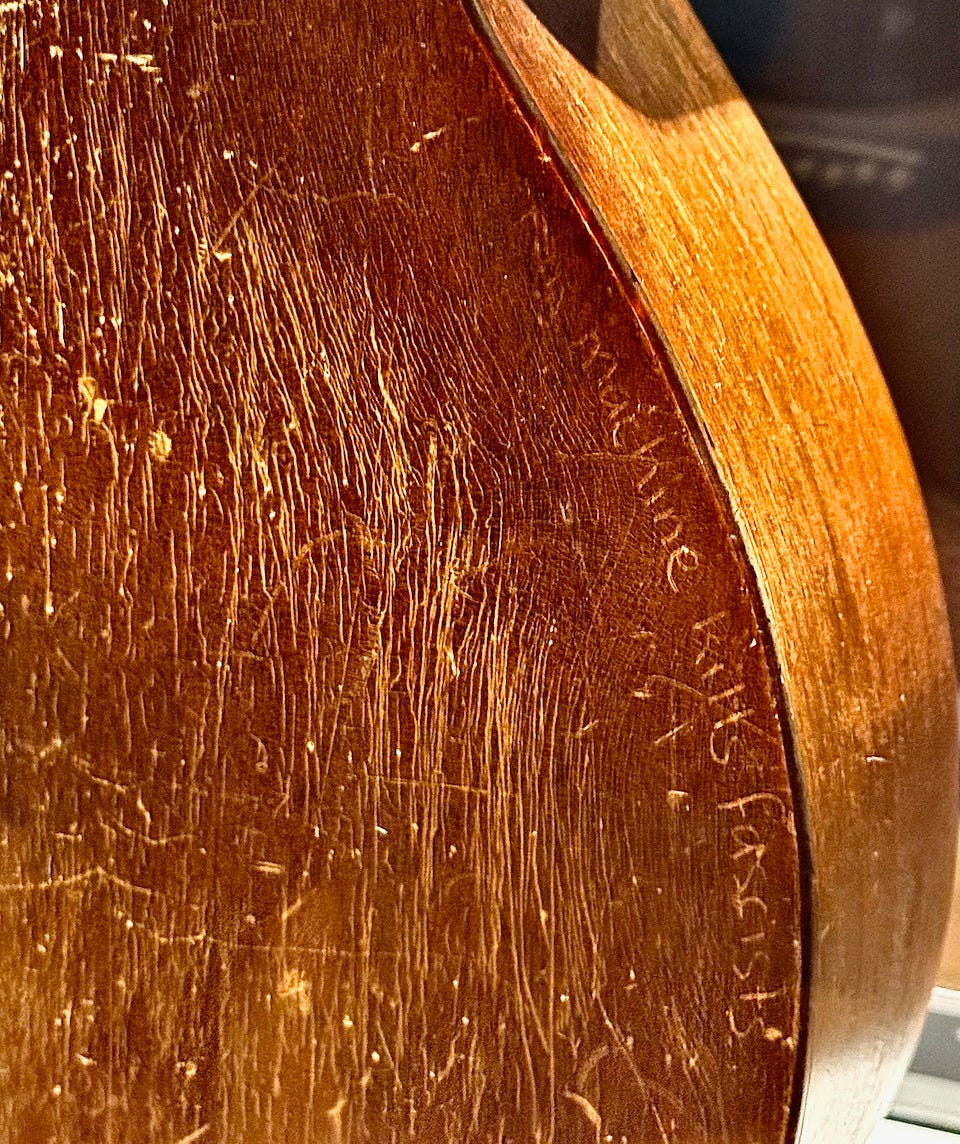
My photo of the Woody guitar, now on display at the Huntington outside L.A., alleged to be first one that carried his “This machine kills fascists” etched on back.
Happy Birthday Woody!
And Greg, thanks for doing your part!
Happy Birthday Woody. Greg, congrats on a fine film. Thoroughly enjoyable and informative. I’m attaching a link for another great Bruce performance, this one is “Vigilante Man”
https://youtu.be/eKXILNMXxs0?is=fIJ89ZU3icUZ8hz7